

To become a Canadian citizen, applicants aged 18 to 54 must prove they can speak and listen in English or French at Canadian Language Benchmark (CLB) level 4 or higher. You can prove it with an approved test such as CELPIP-General LS or IELTS General Training, with a diploma or transcript from schooling in English or French, or with a certificate from certain government-funded language classes.
This guide focuses on the proof itself: which documents IRCC accepts, the minimum test scores, whether old results still count, and the simplest way to meet the rule. For the bigger picture on citizenship, see our Canadian citizenship language page.
Who needs to prove language skills for Canadian citizenship?
IRCC says that if you are 18 to 54 years of age, you must submit proof that you can speak and listen at CLB level 4 or higher in English or French. If you are 17 or younger, or 55 or older, this language proof is not part of your application.
A few points are worth knowing before you start:
- Only speaking and listening count. Reading and writing are not assessed for this requirement.
- English or French, not both. One official language at CLB/NCLC 4 is enough.
- It is pass or fail. A score above CLB 4 gives you no extra advantage, so there is no reason to chase a high band.
Missing proof is a costly mistake. IRCC says your application will be returned to you if the language proof can't be read, can't be verified, isn't included, or is in another language without a certified translation. A returned application means starting the paperwork again.
What documents can I use as language proof for citizenship?
IRCC accepts three types of proof. You only need one of them.
| Type of proof | What it looks like | Key condition |
|---|---|---|
| Approved third-party language test | Test result report (CELPIP, IELTS, PTE Core, TEF, TCF and others listed below) | Must meet the minimum listening and speaking scores |
| Education in English or French | Diploma, transcript or certificate from a secondary or post-secondary program, in Canada or abroad | Must show the program was taught in English or French |
| Government-funded language training | LINC or CLIC certificate, or an accepted provincial program certificate | Must show CLB/NCLC 4 or higher in speaking and listening |
For education, IRCC accepts proof that you completed or are attending a secondary or post-secondary program in English or French. If the document is not in English or French, you need a certified translation that shows the program's language of instruction.
For language classes, the federal programs are LINC and CLIC. Some provincial programs are also listed (British Columbia, Manitoba, Nova Scotia, Ontario, Quebec and Saskatchewan at the time of writing). IRCC does not accept certificates from private language schools.
Which language tests are accepted for Canadian citizenship?
IRCC's help centre lists the accepted third-party tests and says it doesn't accept any other test results. Minimum scores below come from IRCC's language proof tool.
| Test | Language | Minimum listening | Minimum speaking |
|---|---|---|---|
| CELPIP-General or CELPIP-General LS | English | 4 | 4 |
| IELTS General Training | English | 4.5 | 4.0 |
| PTE Core | English | 28 | 42 |
| TEF Canada, TEFAQ, TEF IRN | French | B1 or higher (B2, C1 or C2) | B1 or higher (B2, C1 or C2) |
| TCF Canada, TCFQ | French | B1 or higher (B2, C1 or C2) | B1 or higher (B2, C1 or C2) |
| DELF | French | B1 or higher (B2, C1 or C2) | B1 or higher (B2, C1 or C2) |
| DALF | French | All results accepted | All results accepted |
Notice that the IELTS bar is not the same for both skills: 4.5 in listening but 4.0 in speaking. Those are the IELTS bands that match CLB 4 in IRCC's conversion table. CELPIP is simpler because CELPIP levels line up one-to-one with CLB levels, so a 4 is a CLB 4.
Two tests on the list only cover listening and speaking: CELPIP-General LS and TEF IRN (formerly called TEF pour naturalisation). They exist mainly for citizenship applicants, since you don't need reading and writing scores here. For a closer look at how scores convert, see our CELPIP score chart.
Can I use an old or expired language test for citizenship?
Yes. This is one of the biggest differences from immigration applications. IRCC's help centre says: “There is no expiration date for third-party language test results for citizenship applicants.” You can also send the same test results you used for your permanent residence application.
There is one catch. The minimum score depends on when you took the test, because the conversion rules have changed over the years. IRCC's step-by-step tool asks which test you took and the test date, then shows the minimum for that period. For example, a CELPIP-General test taken on or after April 1, 2014 needs 4 or higher in listening and speaking.
So if you immigrated through Express Entry with a CELPIP or IELTS score that met CLB 7, that old result almost certainly clears CLB 4 in listening and speaking, even though it is far older than two years. Check it in the IRCC tool before you book anything new.
Compare that with Express Entry and the post-graduation work permit, where results must be less than two years old. Our guide to results validity explains those rules.
What is the cheapest and simplest way to prove language for citizenship?
Work through these options in order. Each one costs less effort than the next.
- Reuse your PR test results. If you sent CELPIP, IELTS, TEF or another approved test with your permanent residence application, and it meets the minimum for its test date, you can send it again. It costs nothing.
- Use your education. A high school or post-secondary diploma or transcript from a program taught in English or French works, whether you studied in Canada or abroad. Many applicants already have this.
- Use a LINC or CLIC certificate. If you completed government-funded classes at CLB 4 or higher in speaking and listening, your certificate counts.
- Book a two-skill test. If none of the above applies, CELPIP-General LS or TEF IRN tests only the two skills you need, so it is shorter than a full test. On celpip.ca, CELPIP-General LS costs $199 plus applicable taxes in Canada.
If you need a test, the format matters more than the target score. CLB 4 is a modest level, but nervous test-takers can still fall short in speaking if they freeze or run out of time. A few practice sessions with timed speaking tasks usually solve that. Our CELPIP Speaking templates and sample answers and CELPIP Listening tips cover both skills.
Is the citizenship test the same as the language test?
No. They are two separate requirements, and people often mix them up.
- Language proof shows you can speak and listen in English or French at CLB 4. You send it with your application.
- The citizenship test checks your knowledge of Canada. Like the language requirement, it applies if you are 18 to 54 years old on the day you sign your application (canada.ca). It is based on the only official study guide, Discover Canada: The Rights and Responsibilities of Citizenship.
Passing a language test does not replace the knowledge test, and passing the knowledge test does not prove your language level. Plan for both. The good news is that the listening and speaking practice you do for a language test also makes the citizenship study guide and any interview easier to handle.
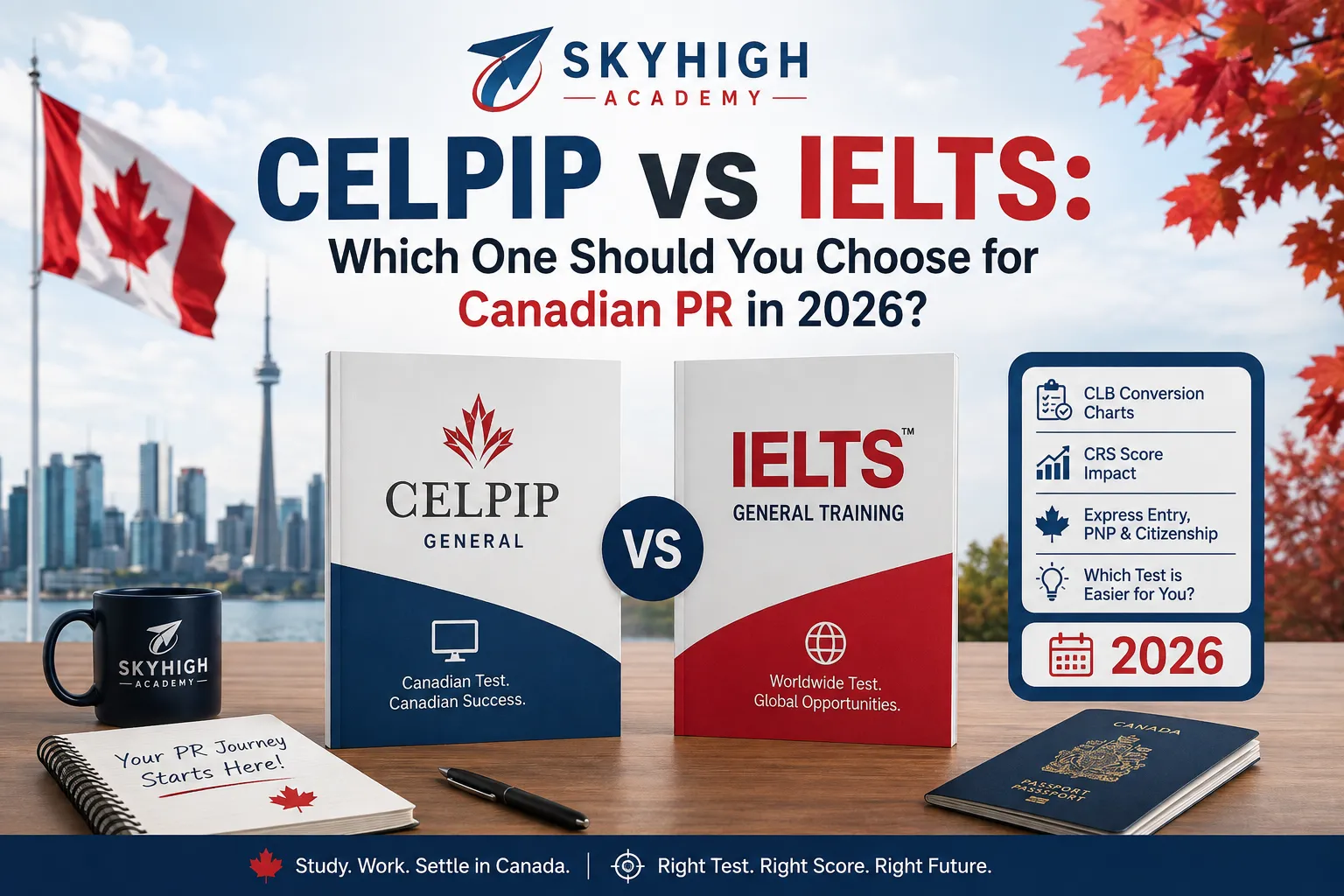
Should I choose CELPIP-General LS or IELTS General Training?
Both are accepted, and CLB 4 is reachable on either one. The choice comes down to format.
| CELPIP-General LS | IELTS General Training | |
|---|---|---|
| Skills tested | Listening and speaking only | All four skills (listening, reading, writing, speaking) |
| English accent | Canadian English | A range of English accents |
| Speaking format | Recorded on a computer | Face-to-face with an examiner |
| Citizenship minimum | 4 in listening and speaking | 4.5 listening, 4.0 speaking |
If you only need citizenship proof and are comfortable on a computer, CELPIP-General LS is the most direct route. If you might also need a full four-skill result later, for example for Express Entry or a work permit, a full test may be more useful. Our CELPIP vs IELTS comparison goes into more detail.
Getting ready for your citizenship language test
If you need a test and want to pass it the first time, Sky High Acdmy's CELPIP course covers listening and speaking with timed practice and one-on-one feedback, and our IELTS course covers General Training. All training is personal (one-on-one) and live online, the first class is free, and each course is $350 CAD (or $90 CAD a week for weekly training). Book your free class.
Sources
- IRCC: Find out if you have the language proof for citizenship (Step 1)
- IRCC: Language proof for citizenship, Step 2 (previous test results)
- IRCC: Language proof for citizenship, Step 5 (accepted tests and scores)
- IRCC Help Centre: Documents to prove the citizenship language requirement
- IRCC Help Centre: Third-party language tests accepted for citizenship
- IRCC Help Centre: Government-funded language programs for citizenship
- IRCC Help Centre: Reusing immigration test results for citizenship
- IRCC: Citizenship eligibility (ages 18-54 for language and test)
- IRCC: Discover Canada study guide
- CELPIP: Canadian Citizenship (CELPIP-General LS fee)